Reproduced from: http://www.indialegallive.com/viewpoint/violence-against-doctors-lethal-blow-70584,
published August 11, 2019
In a positive development, a draft bill has proposed that violence
against Doctors be made a criminal offence, resulting in hefty fines and a jail
term according to the type of assault
By Dr KK Aggarwal
A doctor’s profession is one of the most sacred. His
basic role is to relieve the sufferings and pain of an individual. In most
other professions, people charge for providing services during an emergency,
but not doctors.
Under Article 21 of the Constitution, health is a
fundamental right and under Article 47 of the Directive Principles of State
Policy, both primary and urgent care are to be provided free by the State.
Currently, most states are not able to provide effective emergency medical care
to their residents and the load is transferred to the private sector which
charges exorbitantly. Also, many government hospitals do not take patients on
ventilators, deliveries booked outside for C-section, acute terminal care,
new-borns delivered outside with sepsis, etc. The costs of acute care in a good
private hospital may vary from Rs 50,000 to Rs 1 lakh a day, which is beyond
the capacity of most people. Insurance companies also do not cover much of the
cost. The result is instances of assault and violence against doctors.
Now the time has come when not only the medical
fraternity, but the public at large should be concerned about the rising
incidents of violence against health personnel. But in a positive development,
hefty punishments are proposed to be imposed on those who indulge in such acts.
If doctors and other healthcare staff are under constant threat, they will not
be able to treat patients. If nothing is done immediately to curb this, a time
will come when there will be very few doctors. As of now, even the brightest
students prefer non-clinical practice. Amulya R, a gold medallist MBBS student
from Bidar Institute of Medical Sciences, Bengaluru, said in an interview on
March 18, 2017: “It really upsets me the way doctors are assaulted these days.
Looking at these incidents, I would prefer a non-clinical subject like
pathology for my post-graduation.”
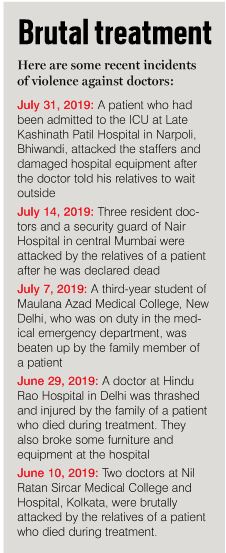
Some incidents of assault have even caused deaths of
doctors. In many cases, grievous injuries have been inflicted and public
property damaged. In a case in 2017, a senior orthopaedic resident, Rohan
Mahamumkar, lost vision in his left eye after being assaulted by the relatives
of a patient who had been brought in with a head injury at Government Medical
College in Dhule. Mahamumkar had asked the patient’s family to take him to
another centre as no neurosurgeon was available at that time. This infuriated
them enough to attack him.
There are many reasons for frequent incidents of violence
and assault on doctors: Shortage of facilities and medical professionals in
government/public hospitals; poor doctor-patient ratio; poor arrangement of
safety and security of healthcare professionals in government hospitals and
lack of efficient management and administration.
In the last few years, state governments/Union
Territories (UTs) have been deliberating on the issue of violence against
medical personnel. Till date, 18 states/UTs have brought in legislation on this
subject, including Delhi, during the period 2007-13. In a majority of them, the
offence of violence and assault has been made cognisable and non-bailable with
imprisonment up to three years and a fine up to Rs 50,000.
Despite this, the biggest problem is lack of awareness
among police authorities and inaction on their part in registering a criminal
case against accused persons. Violence against doctors and any person is also a
punishable offence under the Indian Penal Code (IPC). Yet, there is a need for
a central law for the protection of doctors. The medical fraternity has been
demanding this for quite some time.
After much persuasion, in 2015, under pressure from the
IMA, the central government constituted a committee to examine the issue of
violence against doctors. The report of the committee was finalised on
March 23, 2017, wherein it recommended the following measures:
·
The ministry of
health shall suggest to all states which do not have specific legislation to
protect doctors/health professionals to consider enacting one.
·
The ministry shall
write to all states to strictly enforce the provisions of the special
legislation wherever it exists and/or enforce the IPC/CrPC provisions with
vigour.
·
The ministry shall
explore the possibility of initiating the process to bring a central act on the
issue in line with those in vogue in other states.
However, the central government did nothing on these
recommendations, eventually leading to increased assault cases and a nationwide
strike by doctors. After one such incident of assault in West Bengal, the
centre constituted an inter-ministerial committee which promised to enact a
central act soon.
The draft Bill for the protection of doctors was
presented to a 10-member committee constituted by the health ministry in July
to see the feasibility of it being made into a central law and to make it a
criminal offence under the IPC and the CrPC. The committee decided that such a
law was needed, and an eight-member subcommittee was created to draft the Bill.
As per the draft Bill, assaulting and “grievously injuring” doctors on duty can
result in 10-year imprisonment or fine up to Rs 10 lakh.
The most important aspect of the draft Bill is the
gradation system, which will consider the type of assault and prescribe the
punishment accordingly. For example, the minimum punishment would be six
months’ imprisonment and/or Rs 50,000 fine for a simple injury. The maximum
punishment would be five years’ imprisonment and/or Rs 5 lakh fine. For a
serious injury due to which a doctor has to miss work for 20 days, the
punishment would be imprisonment between two to 10 years and fine between Rs 2
lakh and Rs 10 lakh.
The Bill will make assault on doctors a cognisable and
non-bailable offence, which means that an accused person can be arrested
without a warrant and will need to approach a magistrate or court for bail. The
Bill does not address injuries that might lead to death as that is already
covered under the IPC/CrPC. The draft Bill also does not make provisions for an
institutional FIR, which was a request raised by the Federation of Resident
Doctors’ Association.
However, enacting a central law is not the only solution.
Other solutions which are vital are:
·
State laws dealing
with violence against doctors should be advertised.
·
Workshops, seminars,
etc, should be organised to educate the public and doctors about the penal
provisions.
·
Patients’ rights
should be displayed in every hospital and clinic.
·
Patients should be
educated about the significance of informed consent, triage in emergency and
sensitised that error of judgement does not automatically mean negligence.
·
There should be a
grievance redressal mechanism for both patients and doctors in every healthcare
establishment.
·
Right communication
is the key to a strong doctor-patient relationship.
·
The charges on
patients should be clear and transparent.
·
There should be
rational treatment, rational prescription and transparency in investigations
and treatment.
·
Hospitals should
identify high-risk areas and install audio-based CCTV cameras there.
·
Bodies of deceased
patients cannot be held hostage for financial disputes.
·
Hospitals should
make adequate security arrangements for the protection of doctors and nurses,
especially in the night.
·
CPR and first-aid
should be made available everywhere.
·
There must be a
provision for briefing the legal heirs.
·
Nurses and
paramedical staff should be trained in soft communication.
The media and police too have an important role to play
in preventing violence against doctors and hospital staff. No news article
should be published without proper verification. Police officers should be
sensitised about violence against doctors and the laws and guidelines laid down
by the Supreme Court.
It is a sad reflection of our society that the very
people who look after others are now being made victims for no fault of theirs.

Dr KK Aggarwal
Padma Shri Awardee
President Elect Confederation of
Medical Associations in Asia and Oceania
(CMAAO)
Group Editor-in-Chief IJCP Publications
President Heart Care Foundation of
India
Past National President
IMA